 |
| http://wavemark.com/uploaded/items/banner_b907dcd8-3882-4ec5-bdfc-791a0458aeb9_.png |
Radio-frequency identification is the wireless use of electromagnetic fields to transfer data, for the purposes of automatically identifying and tracking tags attached to objects. The tags contain electronically stored information. The chip typically is capable of carrying 2,000 bytes of data or less. Some tags are powered by electromagnetic induction from magnetic fields produced near the reader. Some types collect energy from the interrogating radio waves and act as a passive transponder. Other types have a local power source such as a battery and may operate at hundreds of meters from the reader. Unlike a barcode, the tag does not necessarily need to be within line of sight of the reader, and may be embedded in the tracked object. Radio frequency identification is one method for Automatic Identification and Data Capture.
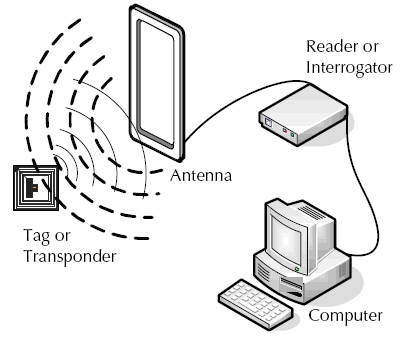
A RFID system is made up of two parts: a tag or label and a reader. RFID tags or labels are embedded with a transmitter and a receiver. The RFID component on the tags have two parts: a microchip that stores and processes information, and an antenna to receive and transmit a signal. The tag contains the specific serial number for one specific object.
 |
| http://www.epc-rfid.info/wp-content/themes/gintinfo/images/how%20rfid%20works.png |
Sources:

No comments:
Post a Comment